South Bend gets more snow than the rest of Indiana. Your driveway knows it. South Bend Concrete plans Michiana concrete that handles what Lake Michigan sends every winter.Call (574) 727-2611

Concrete Driveway Replacement in South Bend, IN

Replacement is not simply a new layer over old concrete. The existing driveway comes out so the base, drainage, thickness, panel layout, garage approach, and street apron can be reviewed and corrected where needed. That below-surface work is especially important when the old driveway has heaved, settled, held water, or broken along the same lines for years. Call Mike at (574) 727-2611 with the address, photos, rough dimensions, access limits, and the problems you want the new layout to solve.

Call directly
(574) 727-2611

Call (574) 727-2611 or use the homepage contact form. Include the address, photos if available, drainage concerns, and what is cracked, settling, or holding water.

Concrete driveway replacement area with prepared base and forms

Know why the old driveway is coming out

Widespread cracking, displaced panels, deep surface failure, repeated patch loss, poor drainage, and unstable garage transitions are common reasons to consider replacement. The defect pattern helps shape the new scope. If settlement is concentrated beside a downspout, drainage deserves attention. If the apron is deteriorated while upper panels remain sound, partial work may be discussed. If the full drive has multiple moving panels, replacing only the worst-looking square may leave the main problem in place.

Replacement should also account for how the driveway is used. Vehicle count, turning, trailers, delivery access, snow storage, side-door paths, basketball goals, and the route to the backyard can affect width and joint layout. A direct copy of an inconvenient old driveway may miss the chance to improve the daily use of the property.

Tear-out reveals the conditions that matter

Removal and haul-out expose the existing base and soil. That is when soft areas, inconsistent stone depth, trapped water, buried debris, old utility trenches, and washed-out edges can become visible. The new plan should respond to what is found rather than assuming every square foot below the old slab is uniform. Access for removal equipment and trucks also affects how demolition is staged.

Protecting nearby garage doors, siding, steps, landscaping, sidewalks, and street edges needs thought before work begins. Homeowners should move vehicles, trailers, planters, hoses, and fragile items away from the work zone. Ask how mail, deliveries, trash bins, and pedestrian access will work while the driveway is unavailable. Good logistics reduce avoidable conflicts without creating a promise that every site follows the same schedule.
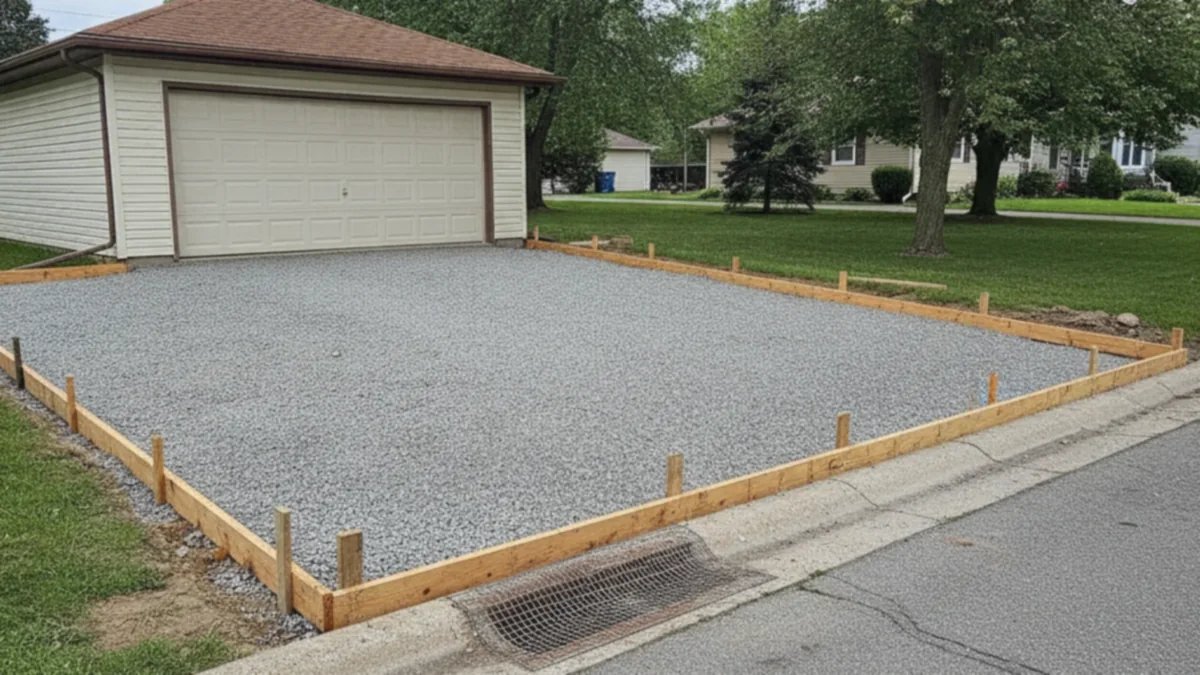
Base support and drainage correction

Northern Indiana soils can hold moisture, and freeze-thaw conditions make poor support visible. The base needs appropriate aggregate, grading, and compaction for the site. Low edges, downspout discharge, neighboring runoff, and the direction of snowmelt should be considered. A new slab cannot correct every yard drainage issue, but its slope should not knowingly send water toward the garage or foundation.

Edge support matters where tires approach from the lawn, where the driveway widens, and where grade drops beside the slab. The street end may receive road salt and snowplow effects, while the garage end must meet the floor and door clearance correctly. These details are not decorative. They determine how water moves and how vehicles cross each transition.

Apron, sidewalk, and garage transitions

The public-side apron, sidewalk crossing, curb relationship, and property boundary should be identified before the scope is finalized. Local requirements or permissions may apply depending on exactly what is disturbed. The estimate should distinguish private driveway work from any right-of-way section rather than assuming they are interchangeable.

At the house, check garage floor height, door seal, threshold, steps, and nearby walkways. A steep or abrupt approach can cause scraping or hold water. Existing garage slabs may have their own cracks and slope, so the new exterior work has to meet a fixed condition. Photos with the garage door open can help explain the transition during the first call.

Concrete finish, joints, and weather

Exterior driveway concrete is commonly planned with a broom finish for traction and with control joints that divide the slab into sensible panels. Joint spacing and geometry should be considered before the pour. Narrow strips, inside corners, utility covers, curves, and wide parking pads can create stress concentrations if the panel plan is treated as an afterthought.

Placement depends on weather and site conditions. Air temperature alone does not tell the whole story. Base condition, rain, wind, sun, slab temperature, and forecast during early curing can affect timing. The surface should then be protected from early traffic and other disturbance according to the mix and conditions. Ask for a clear distinction between foot access and vehicle access.

How replacement is quoted

Driveway replacement is quoted from the measured scope and site conditions rather than a universal two-car or square-foot figure. Long drives, thick or reinforced existing concrete, poor access, drainage correction, apron work, unusual shapes, disposal requirements, and significant base problems can change the work materially.

Call with rough length and width, but do not worry if measurements are approximate. Photos of the street, full driveway, garage transition, side access, cracks, and low areas are often more informative than one number. Mike can use those details to explain the estimate path and whether full or partial replacement deserves an on-site review.

What affects the quote

  • Measured replacement scope: Driveway dimensions, slab thickness, reinforcement, demolition, disposal, base preparation, and pour access shape the quote.
  • Removal and access: Existing thickness, reinforcement, haul route, gates, landscaping, overhead limits, and truck access affect demolition and handling.
  • Base and drainage: Soft soil, insufficient aggregate, washout, slope correction, downspouts, low edges, and transition elevations can add work.
  • Layout and connections: Length, width, parking pads, curves, apron, sidewalk crossing, garage approach, steps, and joint layout shape the quote.

How the work is planned

  1. Scope the failing area. Share dimensions, panel condition, drainage, garage and street transitions, vehicle use, access, utilities, and whether partial replacement is being considered.
  2. Remove and inspect. Existing concrete is broken out and hauled away so base depth, soft areas, moisture, debris, edges, and grade can be evaluated.
  3. Prepare, form, and place. Base correction, compaction, slope, thickness, transitions, forms, exterior mix, finish, and control joints follow the site plan.
  4. Protect and return to use. Pedestrian routes, delivery access, cure protection, cleanup, and vehicle return are explained according to weather and project conditions.

Common questions

How much does driveway replacement cost in South Bend?

Driveway replacement needs a property-specific quote. Dimensions, demolition, slab thickness, reinforcement, disposal, truck access, apron and garage transitions, drainage, and the exposed base all affect the scope. Photos and rough measurements help establish the estimate path.

Can I replace only part of my driveway?

Possibly. Partial replacement can fit when damage is isolated and the remaining panels are supported, correctly sloped, and in usable condition. Joint locations, elevation match, drainage, appearance differences, and the cause of the original failure should be reviewed before choosing the boundary.

What happens to the old concrete?

The replacement scope normally includes breaking out and hauling away the designated concrete. The exposed base is then evaluated for depth, soft spots, drainage, debris, and grade before preparation for the new slab. Access and disposal logistics depend on the property.

When can I park on a replaced driveway?

Vehicle return depends on the mix, weather, slab conditions, and project guidance. Foot traffic and vehicle traffic are not the same. Mike should provide the use sequence for the actual placement. Keep vehicles off until the stated vehicle-use window rather than relying on a generic rule.

What information helps with a driveway replacement quote?

Provide the address, rough length and width, photos from street to garage, cracks and height changes, drainage or pooling, apron and sidewalk details, vehicle use, access limits, and preferred timing. Call Mike at (574) 727-2611 or use the homepage form.

Call (574) 727-2611
Concrete Driveway Replacement South Bend, IN | Tear-Out and Base Plan